Wondercide: A Better Prevention?

*It’s a bit lengthy, but worth a read.* 🙂

With the addition of Jade to our canine family, I was reevaluating my dog budget. (Yes, I’m a budget-er!) I do this simply to track what supplies I need, and how much I am spending on each one. By doing this, I also see what areas I can possibly cut back on my costs.

Bunny Trail: For example, I use fendendazole to worm my dogs. (I plan to do a post some time about the variety of wormers and how to use them.) I had been buying the name brand Panacur C powder formula, which gets expensive- roughly $20 per dog. Since it is very effective, though, I was willing to pay for it. However, I was recently introduced to a liquid form of fenbendazole. Now, instead of paying $60 every few months to worm my girls, I paid $22 for a whole year’s supply! 🙂 That looks great on my budget.

Anyway, with three dogs now, my biggest monthly expense is food. As you can imagine, three dogs eat a lot of food. My second largest monthly expense is flea and tick prevention. As with any medications, I try to use ones that are safe for pregnant dogs. Frontline is one of the few flea and tick preventatives that is safe to use during pregnancy for dogs. Buying doses for three dogs each month costs me about $40.

I have had some concerns, though, about the harshness of Frontline. I don’t want to say that Frontline is a bad product, because it’s not. It’s effective and safe if used properly. However, you are supposed to separate the dog from children and other pets for 24 hours after applying Frontline. This tells me that there is a level of risk (albeit, probably a small risk) in using this product. I know with our dogs, having to keep them apart for a whole day (or even half a day) is a joke.

There were times I did some online research about other more “natural” flea and tick preventatives. Most of them seemed to be of questionable effectiveness; and if I am going to use something, I want it to WORK. I even tried one highly-lauded natural preventative with disastrous results. However, this terrible experiment was what led me to what I believe will be my solution.

I had read about Rose Geranium Oil, which is supposed to be a natural tick preventative. It was bragged up so very much that I decided to give it a try. I got my chance to test it out in March. It was a warm weekend and my husband and I and another couple decided to take our dogs for a hike on the State Game lands near our home. Zach and I took Duchess and Mia, and the other couple took their dog Nina. I knew from previous experience that this area had a booming tick population. I put the recommended two drops of Rose Geranium Oil on my dogs and on myself as well. My husband did not use any kind of repellent. (Foolish man, I thought!)

In talking to the other couple, they told me that they were using Wondercide, a product that repels fleas, ticks, and mosquitoes. (Sounds too good to be true, right?) This wonder spray is human food grade, making it completely safe around kids. Actually, you can use it on kids if you want. (Whoever heard of a food grade flea and tick preventative?) It can also be used on plants, lawns, and furniture. (Whaaaat?)

So we put Wondercide to the test against my Rose Geranium Oil. The results? Check it out.

Zach (human using no repellent)- 0 ticks

Jordan (human using no repellent)- 0 ticks

Sonya (human using Wondercide)- 0 ticks

Nina (canine using Wondercide)- 0 ticks

Kristen (human using Rose Geranium Oil)- 7 ticks

Duchess (canine using Rose Geranium Oil)- 2 ticks

Mia (canine using Rose Geranium Oil)- 11 ticks

I think the results speak for themselves. Even no protection was better than Rose Geranium Oil. I came home and promptly threw away my lousy bottle of oil. 😦 Then I looked up Wondercide, and I liked what I saw. (Here is their website.)

Here are the basics of how Wondercide works, and why I decided to try it. The flea, tick, and mosquito spray is cedar oil based. “Cedar oil affects octopamine, which is essential to life for pheromone-driven pests like fleas and ticks. Octopamine is responsible for regulating heart rate, movement and behavior in pests. Cedar oil blocks the octopamine neurotransmitter receptors in pests, causing pests to be repelled from the area. When contacted, pests suffocate and die. Mammals, birds, fish, amphibians and beneficial insects are not affected by cedar oil because they do not have octopamine neurotransmitters (copied from wondercide.com).”

The budget-conscious part of my brain also kicked in as I looked at this product. Say one bottle of Wondercide, which costs around $20, lasts for one month. That will cut my flea and tick prevention cost in half! (Yay for the budget!)

I bought one bottle of Wondercide flea, tick, and mosquito spray, and I am trying it out for a month. I plan to do a follow up post with my final review and opinion in a few weeks. So far, this is a list of pros and cons I have accumulated.

Pros:

  • It is natural and gentle.
  • It can be used on people (although it is not labeled as a human product).
  • It also repels mosquitoes (the first step in preventing heartworms!).
  • It has other uses beyond just pest control on pets.
  • It is 100% safe around children and other pets- no need to separate!
  • It is safe for use on pregnant and nursing dogs and even puppies.
  • It smells good! 🙂

Cons:

  • It has to be applied very frequently- 2 or 3 times a week.
  • The smell is quite strong when first applied- think Grandma’s cedar chest!

Like I said, I will post about this again in a few weeks after giving it a tough trial run. In the meantime, have any of you had good or bad experiences with Wondercide or other flea and tick preventatives? I would love to hear about it!
The Dog House Series, Part 2: Six Things to Keep Your House From Smelling Like a Dog

*DISCLAIMER* The following is written by a house-automysophobic {one who fears a dirty house}.

You have all been there. To that house where the moment you walk in the door, your nose tells you that there is a dog or cat in residence. You pretend not to notice the hair on the furniture, but you secretly can’t wait to get home and lint roll your clothes.

I have always loved animals, dogs in particular, but I didn’t want a house dog for fear my house would become one of “those” houses. You can then see my dilemma when my husband wanted a house dog. After some thought, I decided to give it a try.

But I made a solemn vow to myself that my house would NOT smell like a dog.

Those are brave words.

It’s been well over a year now since Miss Mia joined our household, and I am happy to say that my home doesn’t smell like a dog! With some strict cleaning regimens and a few tricks of the trade, I think I have learned how to keep my house from becoming “doggy.” Although our dog is a light shedder, I am still incredibly particular about cleaning up any stray hair I find. I care very much about how my house looks and smells. Perhaps I do more than I have to. Perhaps I am a bit of an over-achiever when it comes to battling the dog smell; but, let me tell you, it works.

Here is what I have discovered:

1. If the dog stinks, so does everything else. Giving your dog regular baths is essential! I know some people caution against giving too many baths as it may dry out a dog’s skin. I have not found that to be the case for my dog, however this may depend on the breed. I give my dog a bath every other week, and I use FURminator Deodorizing Waterless Spray every few days to keep my pooch smelling clean in between baths.

2. Brush, brush, brush! Regular brushing serves two purposes. First of all, it keeps your dog’s fur clean, and clean fur looks nicer and smells better. Second, it does an amazing job of keeping hair outside. I recommend brushing at least twice a week. If you’re really disciplined, you can brush every day. It’s also good to get your dog used to brushing. It’s calming for them, and it teaches them to stand still, which is very useful when it comes to giving hair cuts and going to the vet.

3. I hope you like vacuuming. This will sound absurd: I vacuum every day. I am paranoid of my house having dog hair, so I vacuum every day. It works, too. Since we have leather furniture, what little hair our dog does shed all collects on the carpet. If I only vacuum once a week, hairs can become ingrained in the carpet and difficult for the vacuum cleaner to pick up. If I vacuum every day, there is no hair on my carpet. Now, to be realistic, I only vacuum the main carpeted room in our downstairs daily. I don’t do the entire house every day. Oh, and I cheat, too. I have a iRobot Roomba vacuum cleaner that is set on a schedule to come out of its corner and vacuum every day. All I have to do is empty the dirt bin and rescue it if it gets stuck. {Best birthday gift EVER.}

4. Buy a lint roller. Use this as often as you please on pillows, furniture, and clothing.

5. Baking soda is your new best friend. Baking soda is a natural deodorizer. If you have thick, plush carpet, it can trap the doggy smell. It can help to sprinkle the carpet with baking soda a few hours before vacuuming once a week to help keep the carpet smelling fresh. I also make a baking soda air freshener. Fill a spray bottle with warm water. Add roughly 4 tablespoons of baking soda per quart of water. (The ratio can vary.) This will not have a scent; it will simply neutralize the smell of your house. For an extra boost of fresh scent, add a few drops of an essential oil. Spray this throughout your home every few days to keep the dog smell from ever catching hold.

6. Candles never hurt. It’s always good to keep candles on hand for those long winter months when your windows are closed or those damp spring and summer days that have a habit of drawing out strange smells from the woodwork. Candles are a quick way to freshen up the house when company is coming (just to make extra, extra sure there is no hint of dog smell in the air).

Although having a dog in the house means extra cleaning, I have come to love having a four-legged companion by my side. Now that I know it’s possible to have a clean house and a house dog at the same time, I never want to be without a dog in the house. If you have a house dog or are considering getting one, have hope! Find what works for you, and you can have a clean and fresh-smelling house with a dog bed in the corner.

What about you? What have you found helpful (or not helpful) in your home? Please leave a comment with any tips, advice, or questions!

The Dog House Series, Part 1: House Training Your Puppy

So you got a puppy. It’s exciting! They are cute and adorable and innocent… until you see that puddle seeping into the carpet. Then it’s a mad dash for the carpet cleaner followed by grumbling and furious scrubbing.

You stand up, observing the large wet spot on your carpet. Your new furry friend stands happily nearby wagging his tail. This is going to be such fun, and they say that the fun lasts for at least the first several months. If you’re lucky, it may last up to a year.

Don’t panic! House breaking a puppy isn’t nearly as hard as it may seem. To train your puppy as quickly as possible (and with the least amount of accidents and frustration), you must remember these three words:

  1. Routine
  2. Consistency
  3. Patience

It’s all about routine and consistency. Dogs become very accustomed to the routines of their households. (My dog knows my routine so well, that when she sees I am ready to go to work, she runs over to her crate awhile.) With a new puppy, it’s important that you begin to establish a routine, so that he can quickly learn what to expect and what’s expected of him.

Before You Begin

Before you even bring your new friend home, do yourself a favor and have these three items ready to go.

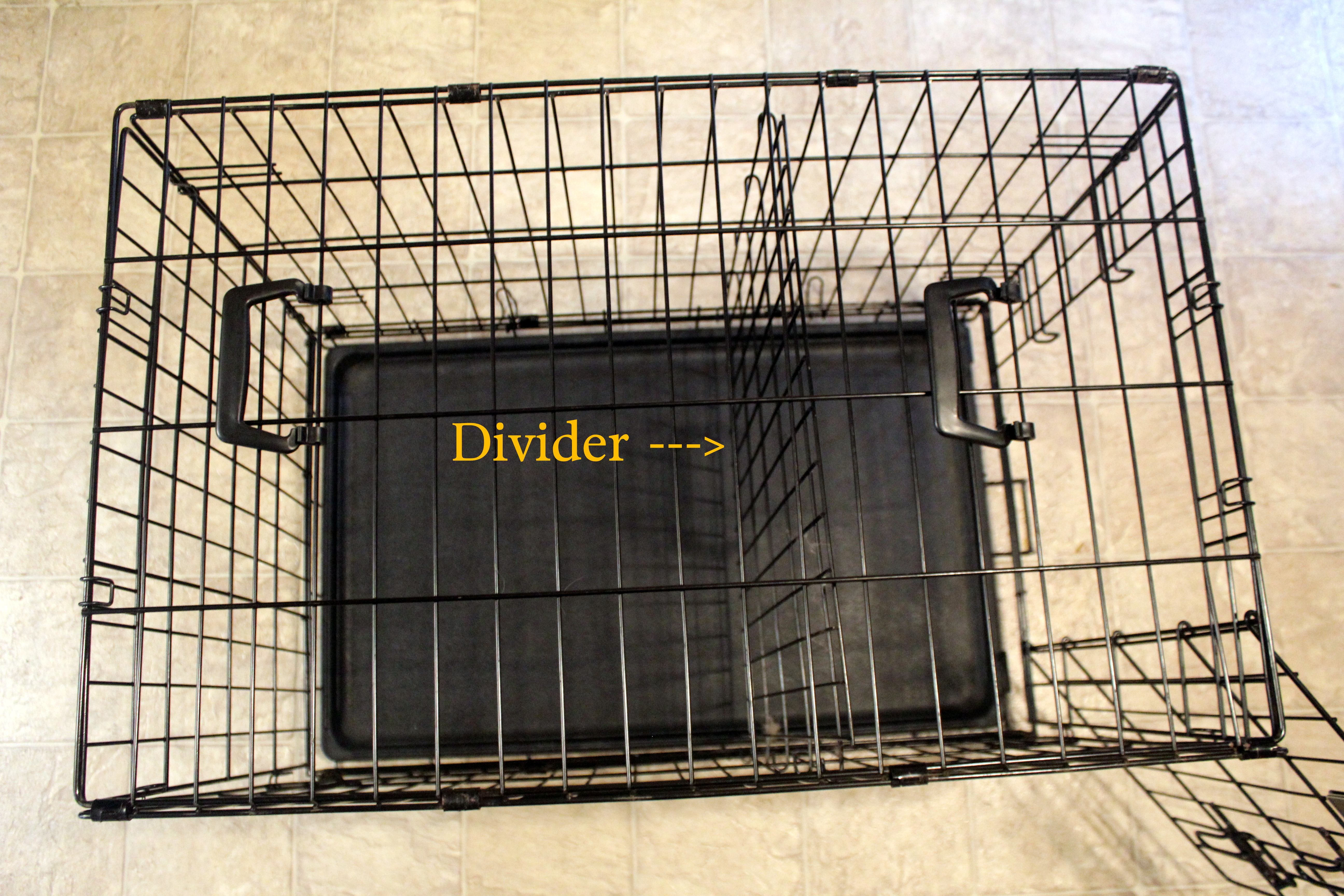
  • A crate- Have an old towel, blanket, or even nothing in it for the first week or until the puppy is crate trained. Also, I recommend buying a crate that has a divider (see picture below). You obviously want to buy a crate large enough for the dog when it is full-grown; but if the puppy is in such a large crate, he will probably pick a corner or two to eliminate in. A divider allows you to make the crate small for the first few months, so the puppy learns that the crate is only for sleeping and has no room for a potty!
  • Carpet cleaner specifically for pets- I use Simple Solution. It works fabulously to take away the smell and the stains.
  • Plenty of cleaning rags- Paper towel won’t work to scrub carpet!

IMG_6609

The First Few Weeks

The first few weeks of having a puppy are the most work; but if you take the time and put the effort into it, it pays off! The first thing you’ll want to do is crate train your puppy. Dogs have a natural instinct not to pee or poo where they sleep, so house training becomes much simpler if you have an established area that’s a “no potty zone.” It’s a place where you can put your puppy where you know he will not eliminate, and it’s a way to teach him to “hold it.”

It’s important to note that puppies from roughly 1-3 months can hold their bladder around one hour during the day and four hours overnight. For the first few weeks, you will have to get up at night to take the puppy out. You are trying to teach them not to go in their crate, and therefore you must give them opportunities to eliminate during the night. From 4-5 months old, most puppies can hold their bladder 2-3 hours during the day and 5-6 hours overnight. These are probably conservative numbers, but I hope it at least gives you a rough idea of what to expect. Medium to large breeds can usually go longer than this in between bathroom breaks.

A good routine for the first few weeks looks something like this:

  • Crate time
  • Take puppy directly to “potty area” outside.
  • If puppy eliminates, praise him and allow him to play inside for about 45 minutes before going back into his crate. Leaving him out longer than that raises the chances for an accident. If the puppy does not eliminate when outside, put him back in his crate for another 15-30 minutes and try again.
  • Repeat
  • Repeat
  • Repeat

By following a strict and consistent schedule, you greatly reduce the number of accidents you will have. Your puppy will soon learn the routine and will begin to recognize the potty area. Try not to play with the puppy when you take him out to do his business. This will distract him. When he eliminates outside, praise him. If he does not eliminate, do not yell or scold him. Simply put him back in his crate. Puppies have so much to learn at their new home! Remember to be patient and gentle.

When the inevitable accident happens inside, do not scold your puppy too harshly. In fact, unless you catch him in the act, you should not scold him at all; because he will not understand why he is being scolded. (Trust me, you will want to scold, but it won’t do you any good.) If you do happen to catch your puppy in the act, give him a firm, “No!” Don’t yell or hit him, because doing so could make your puppy afraid to go to the bathroom in front of you at all. If that happens, it becomes very difficult to teach your puppy the correct place to eliminate.

If you are able to crate train your puppy and stick to a consistent schedule, it will not take long for your pooch to begin to understand. Most puppies who are well trained become “trustworthy” around 7-9 months old. When I say trustworthy, I mean I can take a three hour Sunday afternoon nap and leave my dog alone downstairs. Even if she has to go, she knows to hold it.

As your puppy becomes better with the house breaking, be careful not to give him too much freedom. Once you feel like he has the idea, slowly wean him off your crate, bathroom, play time schedule. Dropping the routine too quickly or too soon can cause the puppy to regress. 😦

As your puppy gets more practice, he will learn to hold his bladder until he can go outside. This can get a bit tricky, though. Even in just a couple of weeks, your puppy will most likely know where the potty area is; but if he has to go when he is inside, he doesn’t know how to get there. He doesn’t know how to tell you he needs to go outside.

Some puppies develop very clear signs to let you know they need to go out (barking, whining, scratching at the door, etc.). Some puppies don’t have obvious signs, or any signs for that matter. This is a difficult part to teach, and each dog is different.

This is how it worked for my dog. Within two or three weeks, she knew where the potty area was. She knew it was good to outside and bad to go inside. However, if she was inside and she needed to go, she just went. She didn’t hold it. I began to notice, though, that often, before an accident, she wandered over to the door. (We always took her out the same door to go to the bathroom.) She didn’t stand there long, but she went over as if to try to go outside. I started to take her outside whenever I saw her walk towards the door. Pretty soon, she learned if she waited at the door, I would take her out. (She did go through a phase where she abused this, and she asked to go out even if she didn’t need to. Over time, though, she learned that she should only ask to go outside if she needed to go to the bathroom.) This step in learning to communicate her need to eliminate was HUGE. Once she could tell me when she needed to go out, I could trust her more. She knew if she waited by the door, she could go outside. She learned to hold her bladder in the house until I let her out. After this point, I felt I was able to wean her slowly off the strict bathroom schedule and gradually allow her more and more freedom.

Every dog is different, and you will have to learn your dog and what his signs are. Just remember to have a routine, be consistent, and, above all, be patient! In a few months, you will have a happy and house trained dog. All of the time and effort you put in to those first few months will definitely be worth it!

Leave a comment to share any advice or experience you have!